Multi-instrument method in Rahsaan Roland Kirk’s “Creole Love Call”

The artist1

Roland Kirk was born in 1935. As an infant, he was blinded, possibly by negligent medical care. He attended the Ohio State School for the blind, where he played in the school band. At the age of sixteen, he led a dance band that performed around the Midwest. It was also at age sixteen that he got the idea to play more than one instrument at once, an innovation he claimed to have received in a dream. He acquired a battery of instruments, including such oddities as the stritch and manzello (obsolete cousins of the saxophone), and set about mastering them individually and in combination.

Kirk recorded as early as 1956, but got little attention until 1960, when critics began to accuse him of gimmickry. Kirk maintained that his unorthodox techniques were born of musical expression rather than cheap showmanship, and his following began to increase.

In 1970, he added “Rahsaan” to his name, having been prompted to do so by another dream.

In 1975, Kirk suffered a stroke that paralyzed his right arm. Kirk continued to perform one-handed. He died in 1977.

The album

Kirk’s album The Inflated Tear is Kirk at his best. Eight of the nine cuts are his own highly original and startlingly varied compositions. Kirk plays tenor saxophone, manzello, stritch, clarinet, flute, whistle, English horn, and flexafone. He is joined by Ron Burton on piano, Steve Novosel on bass, Jimmy Hopps on drums, and *** Griffith on trombone. The 1967 date touches almost as many emotions as Kirk plays instruments.

The tune

Duke Ellington’s “Creole Love Call,” a simple-but-well-loved tune by a revered elder statesman of jazz, seems at first an unsurprising choice for anyone’s album—though interesting in this case as the only selection not composed by Kirk himself. But Kirk’s flair for the extraordinary shapes this performance into a unique musical happening.

Ellington’s best-known arrangement features a pianissimo melody by the reed section, with a clarinet playing the lead part. Kirk’s choice of clarinet and tenor saxophone for his version seems apt, though the complications of playing two instruments simultaneously suggest that this decision could not have been one made without very careful consideration. Kirk manages to include the clarinet melody, altered in places to fit a bluesy shuffle feel, and harmony in the tenor, not to mention covering the vocal part (also in the tenor).

Kirk changes the key from B-flat major to F major (G major for the clarinet and tenor saxophone, both transposing instruments in B-flat). This accommodates the range of notes available using Kirk’s special two-instrument technique. Kirk also shifts the meter from 4/4 to a tripletized 6/4, creating a feel indebted to gospel music as much as to the Ellington band.

The overall effect of Kirk’s rendition is one of respectful but nonimitative tribute. Kirk’s version of “Creole Love Call” is a hard-driving contrast to Ellington’s sleepy Southern portrait. Kirk said, “I did Creole Love Call because words can’t describe what I think of Duke Ellington and his music. The only way I can show how much I dig his music is just to keep on playing.”2

The technique3

Kirk’s performance of “Creole Love Call” is an example of his multi-instrument style using unaltered instruments and relatively few “tricks.” Both clarinet and tenor saxophone have several notes playable with the left (upper) hand only. Kirk uses his left hand on the tenor’s left-hand keys and operates the clarinet’s left-hand keys with his right. The clarinet’s relatively small-diameter bore makes it possible to reach all the necessary keys “right-handed,” but the tenor’s large bore and keys operated with the palm make such a switch impossible.

Putting the saxophone in the left hand presents another problem, however. The tenor saxophone, played in a seated position, generally rests on the saxophonist’s outer right thigh, with its weight supported by a neckstrap and balanced with the right thumb. Moving the saxophone outside the left thigh brings keywork in contact with the leg, causing interference with fingering. It is possible that Kirk used a special stand or other apparatus to hold the instrument, but the low-tech approach of holding the instrument between the legs is a more likely scenario. If held carefully in this manner, none of the keywork is compromised, the inner left thigh can help to balance the instrument, and the keys and mouthpiece can be reached with relative ease.

Adding the clarinet complicates the situation. The weight of the clarinet is usually supported entirely by the right thumb (and balanced with the embouchure, or mouth muscles, leaving the rest of the fingers able to move freely). In this case, however, the right hand is brought out of its usual position near the bell end of the clarinet and used to operate the left-hand keys. A neckstrap can support the clarinet’s weight, but makes no provision for keeping the correct angle for playing. This suggests again that Kirk is playing in a seated position, allowing the bell of the instrument to be rested on the right knee. This position, though a little precarious, makes it possible to play the instrument one-handed. (In attempt to recreate this technique, it would be wise to use a neckstrap anyway—to prevent dropping an expensive and delicate instrument.)

Playing both instruments at once requires a major revision of the standard, “correct” embouchure. Each instrument is normally played with the mouthpiece centered in the mouth. This allows the mouth muscles to provide a supportive cushion on all sides of the mouthpiece. Even slight changes in pressure in any part of the embouchure affect the player’s control of timbre and pitch.

Playing on two mouthpieces at once creates a number of problems: both must be off-center, using weaker and relatively untrained muscles; the slightly different embouchure requirements of tenor saxophone and clarinet and the different sizes of the mouthpieces require an asymmetrical (read: difficult and temperamental) “double” embouchure; and an opening is created in the center of the mouth. To understand the difficulty created by this last point, try inserting two fingers of each hand into the sides of your mouth, then try to close your lips adequately that no air can escape. It is possible only with great effort—and a great deal of tension, an obstacle to good tone, accurate pitch, and range flexibility.

With these difficulties considered, it is surprising that Kirk’s tone on each instrument changes so little during the “solos,” though, admittedly, Kirk’s tone is unarguably unconventional on each. (Any saxophone or clarinet teacher would act quickly to “correct” that kind of tone in a young student.)

The performance

The first chorus of the head is most remarkable for its assurance and refinement. The uninitiated listener would never suspect the same musician is playing the clarinet and saxophone simultaneously. The intonation is especially remarkable to one who has attempted Kirk’s technique; Kirk’s pitch on both instruments is generally above reproach, except perhaps the C (B-flat concert) in measure 16. The articulation is clear and accurate. Of course, ensemble is not an issue—Kirk plays like a pair of well-trained and meticulously rehearsed musicians.

In the second chorus (m. 18), Kirk adds the vocal line (played on tenor). The most technically surprising feat here is the pitch bends in the tenor part. Pitch bends are most often accomplished by a change in “voicing,” involving the position of the back of the tongue (as in creating different vowel sounds in speech). The clarinet’s pitch, however, seems unaffected. Another possible method is to flatten the pitch by loosening the embouchure—impractical in Kirk’s double-horn technique. Kirk may accomplish these pitch bends by partially closing keys, though the smoothness of the bends belies this possibility. The solution to this mystery may lie in Kirk’s choice of notes in the clarinet part. In the first chorus, Kirk uses a sustained G (m.6) and a sustained E (m. 10) in the clarinet melody, but in the second chorus these notes change halfway into a D and a C respectively. There seems at first little reason to complicate the performance further by changing these notes. Closer inspection by a clarinetist, however, will disclose that the G and the E are both somewhat unstable (or easily altered) in terms of pitch, while the D and C are much more resistant to pitch change. A slight voicing change, perhaps used in conjunction with a fingered bend, would give the tenor’s B and B-flat (both easily bent) a bluesy affectation without hurting the clarinet’s pitch.

In the “solo” section, Kirk plays one instrument at a time (clarinet, then tenor), and uses both hands for each.

Kirk’s clarinet solo is a mixture of maturity and naiveté. His use of sustained notes and tremolos seem characteristic of a beginning improviser, but his rhythm and sense for development reveal him as an experienced artist. His note choices, though always appropriate, seem to studiously avoid difficult fingerings. His use of the blues scale in only the low register is especially telling; the B-flat to C to C-sharp would, in either octave of the instrument’s upper range, would strike fear into even a virtuoso’s heart.

The tenor solo suggests Kirk is more at home with this horn. He starts the solo with an altissimo G, a range reserved for advanced players. He also produces a growl on this note by singing and playing at the same time, another sophisticated technique. In measures 44-45 he creates a screaming effect by using the saxophone’s upper partials, an effect favored by rhythm-and-blues players, then improvises a repeating three-note blues motif, another R&B favorite.

In measure 49, Kirk returns to the two horns. He plays a line in octaves that continues into the beginning of measure 52. In this line, Kirk takes advantage of similarities in the horns’ fingerings, essentially doing the same thing with each hand. This suggests that these few measures may actually be improvised, an idea perhaps substantiated by an apparent technical slip-up trying to get back into the melody in measure 52.

The outchorus culminates in a free improvisation on tenor in measure 66. The clarinet continues an “open G” drone, so Kirk is freed to use both hands on the saxophone. The clarinet is, presumably, balanced perilously between embouchure and knee. The length of the final phrase hints that Kirk may be using the circular breathing technique for which he was well known, though it is certainly not impossible for a trained wind player to play a phrase even of this length in a single breath, especially if he has time to get a good breath in before beginning (such as the quarter rest at the end of measure 62).

The verdict

Kirk’s “Creole Love Call” is a success. He rises above the novelty of playing two horns at once and creates a genuine musical masterpiece.

Appendices

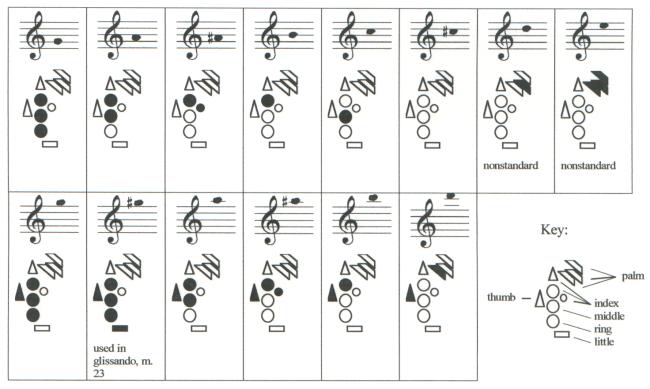
Appendix A: One-handed saxophone fingerings used in “Creole Love Call.” Sound M9 lower.

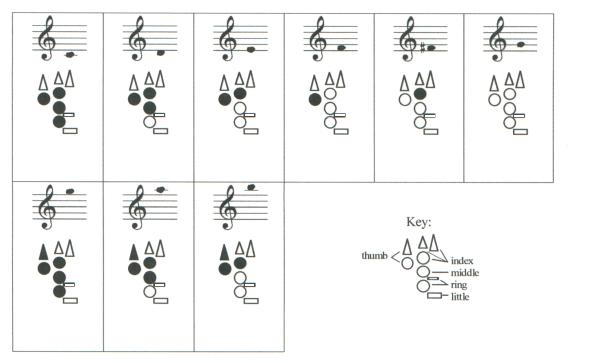
Appendix B: One-handed clarinet fingerings used in “Creole Love Call.” Sound M2 lower. These fingerings are ordinarily played with the left hand, but in this case are played with the right.

Notes

1. Information in this section is compiled from DownBeat.com, The Rahsaan Roland Kirk Web Site, and Michael Fitzgerald’s biography.

2. From liner notes to The Inflated Tear.

3. Information in this section is derived from the author’s own November 2002 attempt to recreate Kirk’s apparently inimitable performance.

Similar Posts

  • Factors in woodwind instrument response

    Response is how readily the equipment/player combination produces sound. “Good” response generally means that the player-plus-instrument are able to produce a sound that starts precisely when intended, with clarity and with no unwanted additional noise. Many factors affect the quality and reliability of the response:

    • Instrument condition. An instrument with leaks, cracks, problematic dents, etc. will often respond in a delayed or unpredictable way.
    • Instrument quality. The instrument’s design and manufacture also play a role—an instrument of inferior design/build may respond inconsistently.
    • Setup. Mouthpieces and reeds are similarly subject to design and manufacturing flaws, and must also be well-matched to each other and the instrument. A common issue with single-reed instruments, for example, is using a “strength” of reed that isn’t a good fit for the mouthpiece.
    • Breath support. One of the most immediate and effective ways to improve response, even when other factors are less than ideal, is to use powerful, consistent breath support.
    • Embouchure. Any embouchure problem can affect response, but by far the most common is embouchure tightness or tension. Remember that all woodwind embouchures should be relaxed.
    • Voicing. This is one of the least-taught and least-understood, but one of the most crucial aspects of good woodwind playing. Properly-calibrated, steady voicing improves response (and just about everything else).
    • Finger accuracy and timing. Fingers that arrive on their keys or toneholes out of sync, or that fail to form proper seals, impede response like the leaks that they are.
    • Inherent acoustical problems. Even the best-made instruments have some built-in compromises that might make certain notes less responsive even under the best circumstances. A common example is the lowest notes on the flute, the oboe, and the saxophone, which may tend toward slight sluggishness even for the best players and equipment. Players may need to compensate in various ways.
    • Musical context. Related to the acoustical problems of the various woodwinds, certain musical contexts may exacerbate issues. For example, the bassoon has some specific intervals that are hard to slur smoothly, and skilled bassoonists might use special fingerings to improve these.

    For your best response on every note, be sure to address each of the many factors involved.

  • |

    NFA 2011: Woodwind doublers roundtable discussion

    Here I am at the far left saying something brilliant and witty. Tereasa Payne, Shelley Collins, David Weiss, and Jim Walker look on in wonder and delight.

    At this year’s NFA conference, I had the very cool opportunity to be part of a discussion panel about woodwind doubling. The panel was organized by Florida flutist and doubler Tereasa Payne, and moderated by my Delta State colleague Shelley Collins. The panel consisted of me, Tereasa, Hollywood studio great Jim Walker, and David Weiss, who is the ethnic flutes soloist for Broadway’s The Lion King. It was an honor to be included in a group of such stature!

    We spoke to a surprisingly large and enthusiastic crowd. At one point Shelley asked for a show of hands by the doublers in the audience, and we were blown away by all the hands that shot up. The audience asked great questions, and many stayed afterward to talk some more. I was delighted to meet several of you personally who read this blog or who have communicated with me by email or on Twitter.

    In advance of the panel, Tereasa had prepared some questions for the panelists to think over. I took some notes to organize my thoughts, and I’m providing them here in an edited version. This isn’t a transcript of the live panel, but it should give you an idea of what was talked about, and of my thoughts about some of those topics. Read More “NFA 2011: Woodwind doublers roundtable discussion”

  • Duco cement and bassoon reeds

    duco cementSince I moved to the lovely and historic Mississippi Delta about two and a half months ago, it has been on my to-do list to find a local source for Duco cement to use in bassoon reedmaking. I used to be able to buy it at a certain notorious chain store, but my local store here doesn’t stock it. One well-known double reed supplier sells it for $3.95 per one-ounce tube, which is four times the price I usually pay for it locally.

    The Devcon website makes it hard to find information about retail locations, and in fact you have to head over to another web domain to find it. After an unsuccessful morning driving around looking for Duco, I went home and dug up this link:

    http://www.itwconsumer.com/wheretobuy.aspx [update: link dead]

    Select DUCO® CEMENT, TUBE CARDED and your state. The website doesn’t give retailer addresses, but does provide names. I found a store within a half-mile of me that had it for just under a dollar per tube. Read More “Duco cement and bassoon reeds”

  • Accents and the tongue (or not)

    As a follow-up to my previous post on the role of the tongue in articulation, I would like to address the problem of accents.

    When I hear my students playing heavy, thumpy accents, I ask them how they are playing the accents. The answer is usually the same: “tongue harder?”

    But when the tongue is properly understood to release the reed (or release the airstream on the flute), the idea of tonguing harder doesn’t make much sense. (How do you release harder?) Unfortunately, for many developing woodwind players, it translates to a larger area of contact between the tongue and the reed, causing unwanted percussive sounds.

    accent

    Accents are better understood as what they appear to be on the page: small decrescendos. An accent is a note shape: louder at the beginning, softer at the end. It is produced by the mechanisms of volume/dynamics, not the tongue. Often, but not always, the note starts louder than the baseline dynamic level and decrescendos back to it.

    As with most aspects of musical interpretation, this leaves a great deal of room for variation; accents can have many characters and shades. But none of those should include thuds or thumps (unless, I suppose, called for by the composer). Practice beautiful and stylish accents by slowing down the music enough to give each accented note a graceful decrescendo.

  • Student-selected online woodwind pedagogy articles

    If you are teaching a woodwind methods course, you might be interested in my book.

    In the past I have had my woodwind methods classes make woodwind pedagogy notebooks. The idea is to have them explore some available pedagogical resources, and assemble them into a resource they can use for reference in their future teaching. But that assignment is starting to feel a little weird, especially since I have been trying to go increasingly paperless in my own life, and because it has been increasingly difficult to persuade my digitally-oriented students to go to the actual library and look at actual books.

    To be clear, I’m a lover of libraries, and for me there’s no question that there are tremendously valuable resources there that are not available online (yet?). But it seemed like time to experiment with embracing an online approach to the assignment. So during the past semester I had them each locate some online articles they thought might be useful. Then they used a discussion board to collaborate on vetting the articles for usefulness and author credentials, and to compare their content against the concepts we covered in class.

    I’m going to provide here a heavily-edited report of their results with my own commentary. Some articles were proposed but were rejected by classmates as less useful or credible, and I don’t see any need to list those. Also, I wanted my students to go through the process of vetting online information, but I didn’t entirely agree with their conclusions, so I’m omitting some that I personally think are problematic. (If you’re wondering, my own blog posts were off-limits.)

    photo, Knight Foundation
    photo, Knight Foundation

    Here are some of the articles my students voted to be worthy of inclusion in a digital notebook:

    • Clarinet Basics: Maintenance Habits, written by Julie DeRoche for The Woodwind and The Brasswind. This one was very highly regarded by the class, and I am inclined to agree with their assessment. My students liked the article’s thoroughness and day-to-day applicability. Two cautions with this article: firstly, I think it’s wise to be careful with (paid?) articles from websites that want to sell you things, but Ms. DeRoche’s credentials are above reproach and the information checks out. Secondly, the article does describe briefly the process of oiling a clarinet’s bore, though it does not strongly recommend this procedure. That is probably information best not given to beginners—at that stage it should be prescribed and carried out by a professional.
    • Reed Help for Beginners, written by Sarah Hamilton. This oboe-related article was another top pick by the class, who appreciated its down-to-earth advice, clearly-explained concepts, and helpful illustrations. I agree that this is a great resource, though some of the reed evaluation and adjustment procedures described might be beyond the scope of what a non-oboist band director can or should attempt.
    • Beginner Clarinet Tips, written by “Andrea.” This one is really more of a table of contents to some other articles on the site. My class liked the breadth of material covered and the extensive photos. I find the information to be very similar to much of the conventional wisdom regarding beginning clarinet playing, which mostly but not completely agrees with my preferred approaches.
    • The Big Switch, by Amanda King. My students found this advice on switching students to the bassoon to be useful. I am on record as disagreeing with the premise that beginners should start on some other instrument before switching to the one they want, but the article does raise some relevant points for cases where that is happening.
    • Teaching the Beginning Bassoonist, written by Terry Ewell for The Double Reed. I’m including this excellent article even though it really is geared toward private bassoon teachers rather than band directors; it’s a good example of solid information that would be mismatched to this particular audience. It’s also a good (and relatively harmless) demonstration of the importance of using up-to-date materials, as bassoon reeds now cost well over $6 USD.
    • Tips for Teaching Beginning Flute Players written originally for BandWorld Magazine by Randy Navarre. My students liked the article’s concision and clarity. I generally agree with the information presented.

    I think some good things came out of the assignment, though I still feel like I sold out a little by excusing my students from visiting the library. I stayed fairly hands-off through the discussion process, and that did result in the students selecting some articles that weren’t really a fit for what I wanted them to learn. In the future I might consider being more involved with guiding the discussion. I’m also concerned that the final product—this blog post—isn’t as tangible as an actual notebook, and might not be as ready at hand, but hopefully they have developed some skills in evaluating information they find online.

  • Reed adjustment checklist

    Problems with your clarinet or saxophone reeds?

    1. If you buy into the myth that there are only two or three “good” reeds in a box of ten, you are buying the wrong reeds. There are many, many options available to you. When I’ve got the right brand, cut, and size of reed for my mouthpiece and embouchure, easily eight play respectably well right out of the box. Within 15-20 minutes, I can adjust nine or ten to play quite well, and maybe three or four of those at recital quality. I use the steps below and nothing else.
    2. Um, no.
      Um, no.
      Don’t waste time and cane messing with the topography of the reed’s cut. With all the variation in reeds, the cut is the one thing that is really quite consistent. If you don’t like the cut, shop around some more. If you own a diagram like the one shown here, with elaborate instructions on which tiny sectors of reed you should sand, I recommend that you throw it away.

    3. Make sure the reed is flat. Many aren’t, and one that was flat yesterday may not be flat today. A piece of 600-grit wet-dry sandpaper held against a piece of glass is the perfect tool for this. Concentrate on the part of the reed that contacts the mouthpiece’s table. For $2, I had a local glass shop cut me a 3″×4″ piece of ¼” glass, with the edges ground smooth. You can also use a mirror or window pane. A flattened reed will respond better and squeak less.
    4. Balance the corners. This is the one exception I make for changing the reed’s cut. Well-balanced reeds have a nice clear tone and respond reliably throughout the instrument’s range and at any dynamic level. I find that balancing the corners can correct for much of the asymmetry of a typical reed. Even a reed that already seems pretty good can often be improved. Tom Ridenour’s method is dead simple and strikingly effective—required reading.
    5. If absolutely necessary, clip the tip using a high-quality reed trimmer. I do this to maybe one in twenty reeds. I do it to make a reed feel a little stronger. Clip off the tiniest possible amount at first—a little clip goes a long way. It’s very rare that I clip off more than a tiny bit, and if I do, it rarely works out well.

    That’s it!

Leave a Reply

Your email address will not be published. Required fields are marked *

Comments that take a negative or confrontational tone are subject to email and name verification before being approved. In other words: no anonymous trolls allowed—take responsibility for your words.

This site uses Akismet to reduce spam. Learn how your comment data is processed.