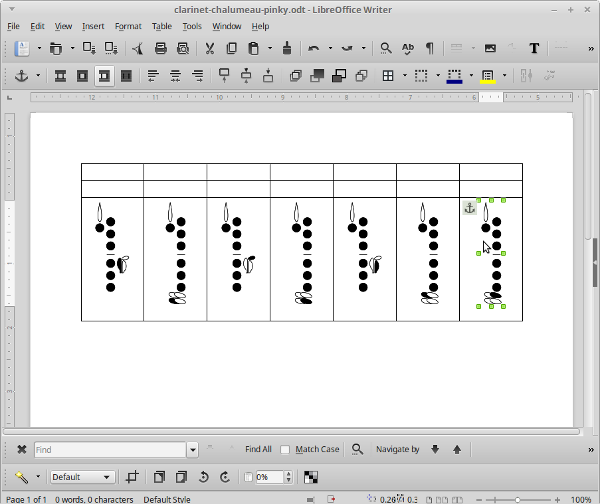
Back in the olden days (2002), I wrote a paper for a college class on Rahsaan Roland Kirk’s simultaneous playing of clarinet and saxophone on “Creole Love Call” from the 1967 album The Inflated Tear. (When I started up this blog, the paper retroactively became a blog post.) In my paper, I included two fingering charts—one for right-handed clarinet, one for left-handed saxophone—that I thought looked pretty good and only took me a few hours to make. Ah, how young I was.
Right-handed clarinet fingering chart. Click for larger.Left-handed saxophone fingering chart.
Clearly, the time has come to update these sad old charts, and the Fingering Diagram Builder makes it fast, easy, and, dare I say it?—fun. I’ll show you how it’s done, using three particularly cool features (if I do say so myself) of the FDB. We will take a look at the FDB’s custom styles, custom keywork presets, and Dropbox integration.
Custom styles
For now, my plan is just to create enough diagrams to replace the ones in these old fingering charts—just the fingerings I figure Kirk must have used. But I don’t think Rahsaan would want me limiting myself to just those fingerings in the future. I’d better set up this project in such a way that I can come back later with new one-handed fingerings I’ve discovered, and add them to the charts with a minimum of fuss.
The problem is that, what with the FDB’s highly customizable diagrams, I may not remember tomorrow whether the ones I made today have lines that are “medium” or “thick” or “heavy,” or whether I sized them “small” or “tiny,” or whether I was saving the diagrams as .PNG files for onscreen use or .TIF files for better printed results. The FDB does, of course, remember my current settings between sessions all on its own, but I like to work on several projects at once (Rahsaan would approve, I think) and I’ll use the FDB’s “custom styles” to keep each project’s configuraton a click away. Here’s how:
First I will set up things just the way I want them. Currently, settings that can be saved as part of a custom style are: diagram size, line thickness, color, file naming procedure (let the FDB name them automatically, or specify each filename myself), file format, save-to location (my computer or my Dropbox), and, if I’m using Dropbox, which folder to save the files in.
Once everything is just right, I’ll click over to the “Custom styles” tab in the FDB’s menu to review my choices, and select which ones I want to save.
As you can see, I’ve set the diagrams to be small, heavy-lined, colored in gray, .PNG-formatted, and saved to Dropbox in a folder called “kirkismyhero.” I have un-checked the box for “File naming,” since I don’t want the FDB to remember that for my purposes on this project—I’ll just go ahead and use whichever system I’m already using that day.
I’ll type in a name (“kirk project”) for my custom style, and click the “Save current settings” button (or press Enter).
I’m done—that’s all there is to it. In the future, whenever I want to create more diagrams like the ones I’m making today, I can just go to the “Custom styles” tab and click on “kirk project.”
Here are a few of my favorite blog articles from 2011, for your re-reading pleasure:
A shocking 187 woodwind doublers participated in my Great Woodwind Doubler Census, and I reported the findings in exhaustive (exhausting?) detail.
I was pleased to announce the releases of versions 0.2 and 0.3 of the Fingering diagram builder, and to introduce a lot of features and improvements. The plan at this point is to continue to work on it as time permits, and I’ve got a few ideas up my sleeve that I hope you will like. I also shared some of the impetus behind the FDB, and some of the problems I hope it will, in a small way, help to solve.
I harnessed some frustration about teaching private lessons, and channeled it into creating a little game (the bidding war between Parker Brothers and Milton Bradley is still ongoing).
I expounded what I think is a really crucial concept in woodwind playing, which the woodwind-blog-reading community received with a deafening roar of almost no attention whatsoever. I guess they can’t all be winners. Come back and read it again when you get into playing ethnic flutes, and thank me later.
Remember, you can keep up with my humble blog in 2012 via feed reader, Twitter, or email. I try to cover a lot of ground here, so if you’re interested in narrowing things down, you can find a blog article you like and click on any of the related “instruments,” “categories,” or “topics,” and then subscribe by RSS or email up near the top of the page, under the main header and just above the first article on the page, like so:
Also, I love to hear from the highly intelligent, talented, and attractive people who read my stuff, so please don’t hesitate to check in if you see something you like, something you don’t like, or something you would like to see more or less of. Or if you just want to say hello.
A number of the other articles that got a lot of traffic and social media love were related to practice techniques and philosophies: one on what I call “anchoring,” one listing some ways to practice technical passages, one about memorizing, one about knowing whether you are playing something “right,” and one about just plain slowing down. Most of these, of course, originate from conversations with my students. We have a lot of conversations about practicing.
I did twelve new installments of my “favorite blog posts” from other people’s woodwind blogs. At this point I have well over 500 woodwind-related blogs in my feed reader, and I at least skim every new post. Many of my favorite posts end up coming from a relatively small handful of extra-good blogs, but that’s not a foregone conclusion and sometimes a dark horse slips in there. If you think I might not be following your blog yet, let me know and I’ll check it out. It has to be at least somewhat woodwind-related and have a syndication feed such as RSS or Atom (most blogging platforms like WordPress or Blogger already have these built in). On a related topic, I’m a little behind on updating my various lists of woodwind players’ sites and blogs (such as the woodwind doublers list), but I’m hoping to catch up in 2o15. Feel free to get in touch if you feel like your site should be listed but isn’t and I’ll give it priority consideration.
I did one set of “required recordings” in January, but skipped August this year since my university reed studio has turned over since I started the required recordings and so I’m in reruns now. When I end up picking some new ones for my students, I’ll share them with y’all too.
There has been a lot of discussion about the problem of musicians being expected to give away their performance talents for free, but I also felt the need to address the idea of original content like blog posts being used by for-profit companies without actual compensation to the creators. This was a reaction to being approached by a woodwind-related company whose products I have purchased frequently over the years, to see if I would like to let them re-“print” some of my blog posts on their website in exchange for what they called “exposure.” I refused but I have witnessed a number of friends and acquaintances boasting about their content being “selected” for this dubious honor. If you are creating original content, I encourage you not to give it away to businesses that do not intend to share their profits with you, even if they try to make it seem like a compliment.
Another year, another April Fools’ Day post that apparently nobody liked but me. I remain undeterred.
As always, there were a few posts that I hoped might generate some lively conversation but didn’t. A couple that spring to mind were one about coaching student chamber ensembles and one about college music study on “auxiliary” instruments (like tenor saxophone or bass clarinet). It’s not too late if you want to chime in.
I introduced some original t-shirt designs that are currently for sale to help support my activities on this blog, and a number of you fashion-forward people are already turning heads in your new woodwind-related apparel. If you don’t have yours yet, be sure to check them out.
If you have read anything interesting or useful here during the past year, I hope you will consider leaving a comment, getting in touch via email or social media, buying a shirt or sending a donation, contacting me about advertising opportunities for your relevant business, and/or pointing your all your woodwind friends toward bretpimentel.com.
Thanks for reading in 2014, and best wishes for the new year!
I’m pleased to announce that I have accepted a new faculty position, teaching clarinet and saxophone at Mississippi State University. It has been a pleasure to work with the clarinet and saxophone studios there on a part-time basis during the past year, and I’m looking forward to hitting the ground running, full-time, in August.
The timing is good, as I’ve just finished my final year at Delta State University due to the closure of its music department (and others) as a cost-saving measure. My heart goes out to those who are still looking for a soft landing.
And if you are looking for a great place to study music, please do reach out! Hail State!
The French bassoon diagram now supports the Ducasse bassoon. Set “Instrument” to “Bassoon (French)” and “Key set” to “Ducasse.” Thanks to Daryn Zubke for assistance with this.
Here are some highlights (to me) of what happened on the blog this year. Thanks for reading, and stay tuned for new, non-meta content once the holidays are over.
A couple of new software projects designed to help bloggers and other web-dwelling folk to use proper musical accidental symbols, and a diatribe about why they should. Some significant improvements to these tools are on the way.