Frequently-asked questions about woodwind doubling, and their unpopular answers

Q. Should I be a woodwind doubler?

A. In most cases, no. If you already feel driven to do it, and have the time and resources to devote to it, then maybe.

Q. What’s the trick to getting in enough practice time on all these instruments?

A. Figure out what to de-prioritize in your life to devote more hours to practicing.

Q. What’s the trick to affording all these instruments?

A. Figure out what to de-prioritize in your life to devote more money to instrument purchases.

Q. What instrument/mouthpiece/etc. should I buy?

A. The one that you have carefully, methodically selected from among dozens or more high-quality specimens, without blindly following internet recommendations.

Q. What’s a good mouthpiece, instrument, etc. for a doubler?

A. Only buy things “for doublers” if you want to sound like a doubler. If you want to sound like, say, a good clarinetist, use what good clarinetists use.

Q. Which instrument should I learn next?

A. Whichever motivates you enough to devote the necessary time and money.

Q. Playing one instrument already means it will be easy to learn another, right?

A. If your goal is to develop only a superficial command of the instrument, then yes. 

Q. How do I know when I am “good enough” at an instrument to count it as one of my doubles?

A. You stop getting fired for how you sound.

Q. How do I get gigs?

A. Sound great, behave professionally, and be liked by the right people.

Similar Posts

  • Practice technique: anchoring

    This is a technique I recommend often to students who are struggling with notey passages. I can’t remember where I picked it up, or whether “anchoring” is my own name for it or someone else’s. No doubt credit for this belongs to somebody smarter than I.

    The problem that I sometimes see with my students (and, okay, occasionally with myself) is that fast passages are uneven and panicky. The student sees a long string of notes and frantically dives in, to the detriment of meter and tempo, and with notes accidentally omitted or added.

    Let’s consider this excerpt:

    from Debussy Première rhapsodie
    from Debussy Première rhapsodie (clarinet)

    It’s a challenging passage—shifting harmony, intervallic motion, awkward fingerings. This is a recipe for frustration using the old standby method of playing slowly with the metronome and gradually increasing the tempo. Instead, let’s set the metronome aside for a few minutes, and play the passage in an intentionally uneven way:

    with added tenuto-accent-fermata
    with added tenuto-accent-fermatas

    Put lots of weight on the metric pulses (the “anchor” notes): play them long, loud, and with emphasis. Hold each fermata long enough to scope out the next four notes, then move through them as quickly as you accurately can, coming to rest again on the next fermata. Repeat the passage in this way as many times as you can stand.

    Here’s what this accomplishes:

    • It makes you think about logical groups of notes, rather than trying either to process each note individually or to deal with the whole phrase as an overwhelming sea of notes. It’s the sweet spot between too much mental chatter and too little focus.
    • It encourages effective phrasing by treating the notes as leading toward downbeats.
    • It trains your ears to hear the notes in fours (at least in this 2/4 passage—try threes instead if the situation calls for it). Now as you return to playing the passage evenly, you are more likely to notice if you are omitting or adding notes.

    To transition from this technique into a more performable approach, gradually decrease the duration of the fermatas and the weight of the accents, while continuing to mentally emphasize the anchor notes and place them carefully in tempo (time to get the metronome back out). Also try spacing the anchors farther apart as an intermediate step—one at the beginning of each measure, for example, or every few measures as appropriate.

    Practice smart!

  • Reader email: doubling opportunities

    woodwinds
    Photo, fantail media

    A reader emailed me to ask this question (edited):

    I was wondering if you could give me some information on what kind of opportunities being a doubler has opened up for you. I am beginning to consider options for graduate school and am looking into multiple woodwinds degrees. Thanks!

    I do consider myself to be at the beginning of a hopefully long career, but doubling has already given me some opportunities that I surely wouldn’t have had otherwise.

    Doubling isn’t a career that typically leads to fame outside the music business, but within the industry many of the best and best-known doublers are working in Broadway pit orchestras, in the Los Angeles recording studios, or on the road with touring jazz or pop acts.

    I haven’t had any of those jobs, nor do I anticipate pursuing any of them at this point. But here are a few things doubling has done for me:

    Doubling gigs. These are gigs where I am actually hired to perform on multiple instruments. Most reasonably large cities in the US seem to have at least a few community or school musical theater productions with large enough budgets to pay a professional or semi-pro orchestra, and woodwind doublers are generally in demand (bonus points for double reed players or “low reeds” players). Doubling gigs can also include being hired as a local to play behind a touring show or artist who is passing through town, or being a sort of utility woodwind player for local orchestras, churches, and so forth. Often for me these have been sort of write-your-own-job-description situations, where I’m hired to play one instrument, and later re-hired because I’m able and willing to cover some other parts, too. Read More “Reader email: doubling opportunities”

  • What I learned going back on the academic job market

    In 2009, I finished a doctoral degree in music performance, and landed a job at a small university in a rural area. Like many young academics, I assumed it would be a stepping stone.

    In those early years, I interviewed for a number of other positions, and generally found that they would be lateral moves. Most of the schools interested in hiring me didn’t pay any better, weren’t any better-located, and didn’t offer a better match for my skills and interests. I stayed long enough to earn tenure, receive a couple of promotions, and carve out a role that suited me well. I also married someone with ties to the region. We bought a house and made plans to stay.

    In 2024, the university announced some serious cuts to academic programs as a cost-saving measure. Each degree program was reduced to a series of metrics in a spreadsheet, and sorted by a calculated financial “value.” Music departments don’t fare well under spreadsheet scrutiny, since we do much of our teaching one-on-one or in small groups, and always need more money for scholarships, grand pianos, and travel. My department was cut, and most of the music faculty, including me, were given one terminal year before being laid off.

    I didn’t expect to be back on the job market mid-career, but things worked out surprisingly well. During that terminal year, my workload—and frankly, my motivation—lightened enough that I had time to also teach part-time at a not-too-far-away, much larger, and more reputable university, due to the sudden retirement of one of their faculty. That put me in good position to interview for the full-time job when it was listed. I was offered the job, accepted the offer, and started in fall of 2025.

    I really couldn’t have been more fortunate about how things worked out, but while things were still up in the air I did find myself facing down some scary realities. While I definitely don’t have all the answers, I’m sharing my experience here in hopes it might be helpful to someone else.

    What seems to have helped me was a combination of luck and an understanding of how music professors get hired. The job market is shrinking and shifting; many variables are beyond anyone’s control. But some are not. You can’t control where positions open. You can try to apply where the fit is genuine and make a case for why that fit matters.

    My first concern was whether I would find jobs to apply to at all. The academic music job market is bleak—too many qualified folks, not enough positions, and job descriptions that are frustratingly specific. Even for woodwind openings (my area), some required background I don’t have, like in wind conducting, marching band, or music theory.

    Then there was the question of where. Preference usually isn’t much of a factor in academic job searches; you go where the job offer is. One possibility I did an early-stage interview for was in an extremely expensive city that would have meant downsizing. Another was in a more affordable area, but with weather that would have meant retooling our entire lifestyle. Finding a good fit less than three hours away—and actually landing it—was far more than I could have hoped for.

    There was also the matter of age and rank. While schools aren’t supposed to consider age, it can be an unspoken factor. I have many good teaching years ahead—but not as many as the freshly minted doctorates also applying. (A mentor even suggested shaving my greying beard to look younger.) My rank as a full professor may also have caused concern that I would expect title, salary, or autonomy that some institutions could not accommodate. One job that seemed like a no-brainer fit never progressed to an in-person interview, and the job went to a much younger (excellent and deserving) candidate. I can’t know why, of course, but I have to wonder.

    On the other hand, I had the much-in-demand “college teaching experience” required in so many job listings. Having served on and chaired hiring committees, I’ve seen applicants without relevant teaching experience get dumped straight into the “no” pile. (For that reason, I strongly suggest that graduate students seek out teaching assistantships or part-time adjunct positions, even if unglamorous or inconvenient.)

    Maybe more importantly, I knew how to frame my candidacy better than when I was a new DMA. In those days I leaned heavily into my nerdy academic interests and my high-minded teaching philosophies. This time, I focused on recruitment strategy, experience working with diverse (and sometimes underprepared) student populations, and a track record of collegiality and flexibility. I tried to present myself as a candidate who could help solve practical problems for my future colleagues and department. Artistic excellence matters, but it’s not enough.

    The opportunity to teach part-time at the institution before the full-time search was likely helpful. I built relationships with faculty, and did a lot of driving back and forth to support recruitment events and student performances. I learned the department’s priorities and pressures, and spent those hours on the road thinking about them. Recruitment and growth were central concerns, and I could show that I already had a local recruiting network that aligned with those goals, including former students now teaching in area schools.

    My younger self thought artistic excellence would determine my career trajectory, and that tenure would secure it. Mid-career me sees things differently. Tenure is not immunity from institutional change.

    I can’t claim to know exactly why I was hired at the new job. Hiring can be kind of a black box. But I do know that I approached the process with a clearer sense of institutional realities, and that I tried to make a case for how I could be useful within them. In a hiring landscape that can feel opaque, that was something I could control.

  • |

    When things get canceled

    I had a very busy final semester of my bachelor’s degree. I was performing with six different university ensembles (one of which was planning a month-long international summer tour), doing woodwind doubling for a musical, teaching at a nearby music school, and preparing for graduate school auditions.

    Then I broke my arm. I slipped on something in a parking lot and landed on my elbow. The doctor put me in a cast from fingertips to shoulder.

    At the time it seemed like the world was coming to an end. But things worked out. I canceled some things and modified or delayed some others. Some kind professors gave me advice and perspective and helped out with some logistics.

    Looking back, it’s barely a bump in the road to where I am now. But I think of it now and then, when the next gig or recital starts to feel like the most important thing I will ever do.

    For my college students, lots of things have been canceled this semester. Some of them won’t get to do their recital class performances or their Honors Recital auditions or their ensemble concerts.

    It’s a shame to miss out on things. But right now there are bigger things going on in the world that demand some changes of plan. And in another year or two, those missed opportunities will be crowded out by all the new ones. A few missed performances will be a war story, not a lasting tragedy.

    (That said, we shouldn’t forget that some musicians’ livelihoods are threatened by things like shutdowns of venues. Now is an excellent time to buy your favorites’ albums and merch to enjoy at home.)

    Stay well, and look forward to the opportunities to come.

  • |

    Teaching multiple instruments in higher education

    My academic credentials in multiple woodwind instruments have served me well so far: I was fortunate to be one among my graduating class who did get a college teaching job right out of school, and it’s a job that happens to be an excellent fit. Part of the reason it’s a great fit is because teaching multiple instruments is what I want to do, at least at this point; sometimes others assume that I’ve taken a multiple-woodwinds job as a stepping stone to something else, but that isn’t the case.

    While I thoroughly enjoy the variety in my day (I’m teaching oboe, clarinet, bassoon, and saxophone), there are some additional things worth considering if you take on multiple instruments in a collegiate teaching career. For example:

    • Resources allocated per faculty member sometimes get spread extra thin. When I arrived at my new job, I was given a little bit of funding for library acquisitions in my area. If I were teaching a single instrument, my current and future students would have benefited from all that money being spent on items directly relevant to them. Instead, I was able to get only a few items related to each instrument. My students, through no fault of their own, got fewer applicable new library resources.
    • Time also gets spread thin. We recently hosted a high school honor band on our campus as a recruiting event. At one point the visiting students were sent to masterclasses with the professors on their instrument, so I got all the reed players. It’s certainly not impossible to run a worthwhile masterclass in that situation, but the circumstances do complicate things a bit. The same problem exists with studio classes for my college students.
    • Some of the work multiplies. When we hold our ensemble auditions, I select audition excerpts and sightreading material for four instruments instead of one. When it’s time to submit textbook orders to the bookstore, I submit separate requests for each instrument’s separate batch of course numbers.
    • It is common for applied music professors to attend their professional organizations’ conferences annually, and to seek out officer positions in those organizations as a way to enhance their tenure portfolios. I would love to attend the annual conferences of the International Double Reed Society, the International Clarinet Association, and the North American Saxophone Alliance each year, but my limited travel funding and the potential time away from my teaching make this unrealistic. And since I don’t attend any one conference every year, it’s difficult to get taken seriously as an officer candidate.
    Photo, Trevor Hempfling Photography
    Photo, Trevor Hempfling Photography

    Not that I am complaining—I am grateful every day that I get to do what I love for a living, and most of these problems can be mitigated with a little effort and creativity. But I think they are worth knowing about if you see yourself headed for a career in college music teaching.


  • Creating fingering charts with diagrams from the Fingering Diagram Builder

    My Fingering Diagram Builder has been around for a little over five years now. I was careful to name it the Fingering Diagram Builder instead of the Fingering Chart Builder because it is a tool for creating individual diagrams, not for assembling them into comprehensive fingering charts. But the difference can be a little confusing, so I get frequent questions from users who complain that they can’t figure out how to create and download a “chart” with multiple fingerings on it.

    The reason I didn’t try to build a complete system for creating fingering charts is that I assumed users would have widely-varying needs, and would do better to assemble charts using some other kind of software. Here are a few examples of how that might be done, using music notation software, using a word processor, and using a text editor to create HTML code (such as for a website). All the software I’m using here is free to download on Windows, Mac OS, and Linux, but whatever free or commercial programs you are already using probably have similar features. You’re on your own to work out the details (and feel free to share them in the comments if you are feeling helpful).

    Creating a fingering chart in music notation software

    I am using MuseScore here, but commercial software like Finale and Sibelius and other free software like LilyPond could be used in similar ways.

    First I set up a musical “score” with the notes for the chart. I used whole notes, separated by double bar lines, but that’s up to you.

    MuseScore setup

    Next I created my fingering diagrams in the FDB. I sized the diagrams “tiny” with “thick” lines.

    Adding the diagrams to the score is very simple in MuseScore—I just dragged the downloaded diagrams from my file manager right onto the score. If I drag the diagram and hover it on top of a note, that note gets highlighted. Then I can release the diagram and it attaches to the note.

    musescore-drop

    Initially the diagrams are placed right on top of the note. I selected the diagrams and used the Inspector panel to give them a horizontal offset of -2.5sp and a vertical offset of -10.5 sp, which moved them above the staff, more or less centered above the noteheads. I adjusted the A and tenor B-flat fingerings’ horizontal offsets a bit more to make them look just right.

    Here is the finished product, a small chart with a few bassoon fingerings:

    bassoon-fingering-chart-sample

    Creating a fingering chart in word processing software

    I am using LibreOffice Writer, but something like Microsoft Word or Apple Pages would work just as well.

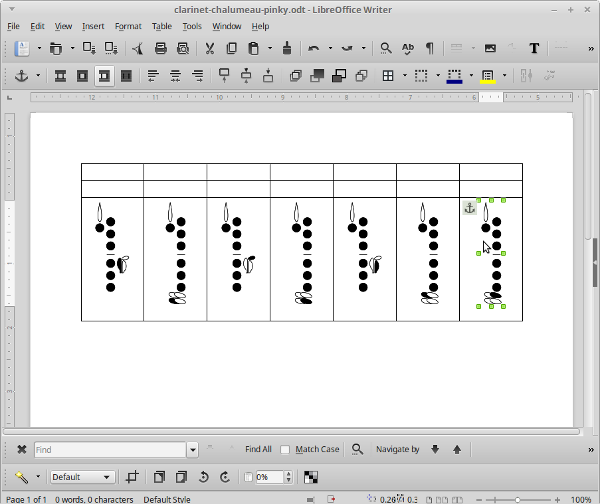
    First I opened a new document and inserted a table. My table has three rows and seven columns.
    writer-table

    Then I dragged the downloaded diagrams from my file manager into the bottom row of the table.

    writer-diagrams

    I merged some cells together, dragged in some images of notes on staves, and added some text.

    writer-complete

    A few more little tweaks and here is the finished chart:

    clarinet-fingering-chart-sample

    Creating an HTML fingering chart in text editing software

    This code be used in any text editor or HTML source editor, and of course similar results could be accomplished with a visual/WYSIWYG editor. I’m not showing complete code here, just the most relevant parts.

    I started with a framework for a table that I could use to show a note with two alternate fingerings. (This is a flute fingering chart with horizontally-oriented diagrams. For an instrument with vertically-oriented diagrams, you may want to rearrange things a bit.)

    <table>
      <tr>
        <th rowspan=2><!— note image here —></th>
        <td><!— first fingering image here —></td>
        <td><!— first fingering text here —></td>
      </tr>
      <tr>
        <td><!— second fingering image here —></td>
        <td><!— second fingering text here —></td>
      </tr>
    </table>
    

    Then I plugged in <img> tags and text:

    <table>
      <tr>
        <th rowspan=2><img src="images/f-sharp-note.png" /></th>
        <td><img src="images/f-sharp-standard.png"</td>
        <td>Standard</td>
      </tr>
      <tr>
        <td><img src="images/f-sharp-trill.png"</td>
        <td>Trill from E</td>
      </tr>
    </table>

    I duplicated that code for additional notes. Since this is a sample alternate/trill fingering chart, each note has at least two fingerings. For notes with more fingerings, I added <tr>s and changed the rowspan values accordingly.

    I also added a little CSS to spruce things up:

    <style>
      table {
        display: inline-block; /* make tables wrap gracefully depending on screen width */
        margin: 1em; /* put some space between tables for legibility/clarity */
      }
      th img {
        max-width: 8em; /* manage size of note images */
      }
    </style>

    Here is the result:

    flute-fingering-chart-sample

    I hope that sparks a few ideas for you if you are considering putting together a fingering chart. If you have other methods or tips, please share in the comments section!

3 Comments

  1. All good thoughts. In terms of instruments, the more you have and play well, the more you work. If you are not relying on woodwind doubling as your main source of income (like me), then I think it’s best to chose the ones you really have a passion for,work hard on them, and don’t worry about the rest. I regularly play Bb clarinet, flute and alto saxophone, occassionally piccolo. I also own a soprano and tenor but they spend most of the time collecting dust. And I have borrowed an alto flute and bass clarinet when absolutely needed. But 3 the primaries are all I truly have time for.

  2. In relation to question one: I’m a teen who started playing pits last year on flute and piccolo a year ago. Since then, I’ve fallen in love with pit, have played in four more musicals and am actively seeking out other gigs to gain experience. In addition, I’ve also taken up the saxophone and have plans to learn as many woodwinds as I can if not all of them. Do you think I should be a woodwind doubler?

  3. Another tip: spend money on lessons with a good (or great) teacher.
    You may think that what you know on your first instrument will transfer easily to other instruments. It wont.

Leave a Reply

Your email address will not be published. Required fields are marked *

Comments that take a negative or confrontational tone are subject to email and name verification before being approved. In other words: no anonymous trolls allowed—take responsibility for your words.

This site uses Akismet to reduce spam. Learn how your comment data is processed.