Woodwind Doubler Census results, part 8: final comments

I decided to leave a space in the survey for general comments, and many of you took the time to remark on a variety of subjects. Many of them were directed to me personally or seemed otherwise non-public in nature, so I’m not going to list them all, but I’ll share a few and summarize the rest.

Some of you politely made suggestions on how the survey could be better:

  • There’s a big gap between “casual dabbler” and “semi-pro”. I suggest an additional category: “serious amateur” or something like that.
  • It would be good to have a skill level between casual dabbler and music major (something along the lines of “good amateur”). As the poll currently is, it suggests that I play recorder to the same standard as sax. I would consider my recorder and flute playing better than “not at all” but my sax and clarinet playing not to be at the level of “music major”, hence they all closest to “casual dabbler”. I guess it’s too late to change the poll now, but I thought I’d offer my opinion anyway :).
  • maybe ask music arranging abilities. Small ensemble writing for different woodwinds is necessary in my working fields.
  • Not sure what your intent is with this data, but I do think that there are some fields that would be nice to have/know of (of course maybe for the next time you do this)…  For example,
    -“what do you consider your strongest/primary instrument”,
    -consider having three columns in the instruments section like:  own/play/don’t own
  • Didn’t know how to answer some of the questions because I’m still a high school student

I think these are all good suggestions, and ones that I would probably take if I could do the survey over. (At this point I have no specific plan for future surveys, but haven’t ruled the idea out, either.)

Some other comments made me think of other questions I wish I had asked. A number of respondents took the opportunity to share some goals and ambitions (everything from getting a first paying gig to making it in the Broadway pit orchestras), which were fun and inspiring to read, and some shared accomplishments of which they are particularly proud (gigs, graduations, retirements, etc.). Others noted the non-woodwind instruments that they also play: piano, guitar, trumpet, valve trombone, tuba, percussion, and concertina were among those reported.

Many of you were kind enough to leave personal notes, or to offer compliments to me about my website, the survey itself, or other things. In particular, people seem to enjoy my list of woodwind doubles in musical theater and my fingering diagram builder. I very much appreciate all the kind words and support, and I can’t thank you enough for your survey participation, emails, RSS subscribes and Twitter follows, and just for stopping by to visit.

I was honored but surprised that several people referred to my website in their comments as a woodwind doubling “community.” While I flatter myself shamelessly that bretpimentel.com is the premier destination for woodwind doublers on the internet, I’ve resisted the idea of starting up discussion forums or other similarly open ways for site visitors to express themselves. If you’re interested in something more like that, check out some of my links to woodwind- or doubling-related forums. I personally skim those forums fairly regularly but post only occasionally. They can be great resources and are run by great people but be aware that their strength and their weakness is that anyone can share an opinion. I encourage you to check the forums out, and to maintain a healthy skepticism about unsourced information that you find there. My website is also full of errors and ill-informed opinions, but they are all my own.

A bunch of awesome people made general offers to help. I very much appreciate the enthusiastic support. Here are a few ways you can help out around here, if you’re so inclined:

  • Leave relevant comments on blog posts that interest you. Brilliance and pithiness are optional but welcome.
  • Subscribe via RSS or email, or follow me on Twitter. Those things help by persuading me that someone out there might actually be reading what I have to say.
  • Share favorite blog posts and stuff via Facebook, Twitter, email, or whatever. A number of new visitors landed here thanks to the efforts of those of you who shared links to the survey. The more, the merrier.
  • Contribute information to the shows list, the blogroll, the lists of woodwind players’ websites, and anything else that seems to be incomplete or inaccurate.
  • If it feels right to do so, donate an amount of your choosing to help defray the costs of hosting the website. The costs, luckily, aren’t huge so far, so even the cost of a cheap clarinet reed or two makes you a major contributor and my BFF.
  • Just drop me a note and let me know what you like, what you don’t like, or what you would like to see on this site. Or just say hello, or ask a question. I try always to respond to comments and questions. Sometimes people email me questions and the answers turn into blog posts.

Thanks once again for your participation in the survey, and I hope you’ve found the results as interesting as I have. I’ll wrap this up with one final survey comment, which I think sums things up nicely:

Life is too short to play only one instrument

Similar Posts

  • New sound clips: Faculty woodwinds recital, Feb. 15, 2010

    Below are a few audio clips from my recent faculty woodwinds recital at Delta State University.

    At this point it’s gotten hard for me to imagine doing a full recital on a single instrument. I enjoy getting to play several, and audiences seem to enjoy the variety. And since this was my first faculty recital at my new gig, I wanted each of my students to hear me perform something from the core repertoire of their instrument.

    I would like, ultimately, to be able to put together a full recital of woodwind pieces without making any special concessions for the fact that I am playing multiple instruments. In this case I did play it a little on the safe side: I chose a program that was not overwhelmingly technical, and I programmed something short of an hour’s worth of music so that I could take a few extra minutes between pieces.

    One note-to-self for next time: I experienced a few onstage symptoms of not being thoroughly warmed up on each instrument (water in oboe toneholes, low note response issues on bassoon). I purposefully avoided playing too much on the day of the recital, but I think I can find a better balance the next time around. Read More “New sound clips: Faculty woodwinds recital, Feb. 15, 2010”

  • Finding information for the Woodwind Doubling in Musicals list

    I continue to be amazed by all the interest in and support for my Woodwind Doubling in Musicals list. I hear frequently from musicians who have information to contribute or who just want to say hello or thanks. It’s pretty great.

    Over ten years ago(!) when I started putting the list together, I spent a good deal of time and effort compiling data. I don’t do that very much anymore, partly because I have already picked over the most obvious sources, partly because I want to focus more time on teaching and playing music, and partly because I get better information when I get emails from woodwind players down in the orchestra pits with the reed books in front of them.

    So these days my role in the list’s upkeep is basically that of editor, data-entry monkey, and mostly-benevolent dictator, and I count on you cool people to send me what you know. In the interest of encouraging and facilitating that, I’m going to dump here (in alphabetical order) some potential resources for gathering information. Maybe some of you know of other sources that you would like to share in the comments section. (I’ll selectively edit them into this post.) Enjoy!

    Woodwind Doubling in Musicals

    Show publishers, rental companies, etc.

    Sometimes these websites list woodwind doublings. You might find that information under something like “orchestration,” or under something like “rental materials.” The information is often vague and has errors, but it’s a start. (Also, keep in mind that I do want submissions for shows that have no reed books, since a verified lack of reed parts can be useful to doublers.)

    Information on specific productions

    Sometimes in sources like this you can find the orchestra personnel, sometimes with their instruments listed. Or you may be able to use this information to, say, Google the orchestra members and possibly get in touch through a personal website or social media account. Please be super considerate and respectful of people’s time and privacy.

    Miscellaneous

    • Google and social media sites. Sometimes people post information from productions, photos of program pages, etc. Sometimes musicians put a brag list on their personal websites of what shows they have played. Or, sometimes you can find out something like a musical director’s name, get in touch, and ask for information (maybe the doubling information itself, or maybe a connection to the woodwind players). Again, be incredibly sensitive about hitting up strangers on the internet.
    • Musical Theatre Reed Book Orchestrations [update: link dead] – I believe this one actually precedes my list, though I didn’t discover it until mine was already online. I don’t think it has been updated in a number of years.

    Have information to submit? Check out the contribution guidelines and send it along. Thanks, you’re awesome.

  • Concept-based woodwind methods

    If you are teaching a woodwind methods course, you might be interested in my book.

    Disclosure: As an Amazon Associate I earn from qualifying purchases, at no cost to you.

    Most college students studying instrumental music education have to take a woodwind “methods” course, a sort of crash course in teaching the woodwind instruments. I have taught woodwind methods classes for about the past ten years.

    A typical approach is to divide the semester into instrument-based units: x weeks studying the flute, x weeks studying the oboe, etc. I’ve taught woodwind methods that way, and it’s tough to get through all the material. How can you realistically cover the pedagogy of five instrument families in one semester? (Some schools offer this scant improvement: two semesters.)

    photo, Kerr Photography

    One big reason that woodwind methods teachers get stuck in the one-instrument-at-a-time paradigm is that existing textbooks, syllabi, etc. treat the woodwinds as being hopelessly different from each other. While the woodwinds are more diverse than the brasses or bowed strings (though perhaps not the percussion), the techniques of playing them are not as unrelated as many seem to believe.

    A symptom of this misunderstanding is the woodwind-methods-by-committee approach, in which a textbook has chapters written by five different authors, or in which a course is taught by a rotating cast of woodwind professors. This invariably leads to holes in the curriculum, confusion over vocabulary, and contradictory ideas.

    I have much, much better success when I focus on the basic concepts underlying good woodwind playing. My course addresses audible aspects of how woodwinds sound (tone, response, intonation, volume/dynamics, fluency), and connects them to elements of playing technique (posture/position, breathing and breath support, voicing, embouchure, tuning, articulation, finger movement, and selection from among alternate fingerings). When my students are conversant in those concepts, it’s almost trivial to apply them to a diverse group of instruments: “the clarinet uses a very high voicing, but the flute uses a very low voicing.”

    That’s still a lot to cover in a semester, but I actually find that I can get through the material efficiently enough to leave some days open for review, Q&A, or special/requested topics. And, more importantly, my students absorb widely-applicable concepts rather than trying to memorize seemingly unrelated factoids about seemingly unrelated instruments.

    This is a valuable approach for woodwind doublers, too, who have to parse out the differences in the instruments but also the differences in culture and tradition that have developed around those instruments and their pedagogy. Understanding the underlying concepts helps to make sense of the sometimes very different approaches to the same problems.

    Warning: commercial-ish plug

    I’ve hinted on the blog a few times about my upcoming book, based on materials I have developed for my woodwind methods courses. It clearly and concisely covers the most crucial concepts in woodwind playing. Since I usually teach a mixed-instrument class I pair it with a band method (such as Essential Elements or Accent on Achievement) for hands-on playing activities, but it would work just as well paired with an individual method (such as the Rubank series) if you have the luxury of a full class set of each instrument.

    I’m hoping to get the book launched before 2017 slips away. If you like, you can join a mailing list to be notified if when it becomes available. Update: the book is now available!

  • Report: John Mack Oboe Camp, 2012

    You know you are at oboe camp when the rules include “no crowing reeds before 7:30 a.m.”

    I’m back from the John Mack Oboe Camp, held every June at the Wildacres Retreat in the mountains of North Carolina. The camp has been an institution for over 30 years, and has been carried on by Mr. Mack’s students since his passing in 2006.

    The JMOC is a a week of intensive oboe study. Most of the 60 or so attendees were motivated undergraduate and graduate oboe students, plus a handful of us in the “30+” category and a smattering of talented teenagers. There is an application but no audition; ability levels ranged from enthusiastic amateur to professional.

    It’s possible to enroll as an auditor, but most attendees participated in masterclasses, performing a Barret or Ferling etude and an orchestral excerpt over the course of the week and getting coaching from the camp’s distinguished faculty (I got to do Barret melody no. 40 and the second movement of the Brahms violin concerto, with coaching from Martin Hebert and Linda Strommen).

    A typical day included morning masterclasses, afternoon workshops or free time, evening masterclasses, and late night snacking and socializing. Other events included a faculty recital, ad-hoc chamber music rehearsals, free oboe adjustments and repairs by John Symer, shopping in the RDG Woodwinds mini-store, a mass oboe choir, and reed evaluation/advice sessions with the faculty.

    The spirit of John Mack was very much present during the week, with the faculty (all Mack protégés) making a point to share wisdom and stories from their studies with him: “As ‘our teacher’ would say…” Having the camp taught by all Mack students gave a nice continuity and unity of message to the masterclasses.

    The week wasn’t all business, though—Wildacres is a paradise with gorgeous mountain vistas, fresh air, deliciously mild summer weather, comfortable lodges, and outdoor activities. It’s also a haven for the arts, that hosts many arts-related camps every year (including several woodwind-related ones). Every space at Wildacres is filled with sculpture, paintings, photography, poetry, and other evidence of the inspiration generations of visitors have found there. There are instructional spaces and a nice little auditorium. The dining hall serves three hearty family-style meals a day, with vegetarian options and other special accommodations available. Internet access and cellular service are spotty at best, but Wildacres spins this as a feature: unplug, relax, and enjoy the here and now.

    I found my fellow campers to be happy, relaxed, supportive, and friendly. The makeshift “reed room” in the main lodge was usually packed, with more experienced reedmakers happy to offer advice.

    The JMOC is a surprisingly good value, as tuition costs less than a week’s hotel stay, but includes lodging, meals, and extensive educational opportunities.

    Highly recommended!

  • 2011 in review, and a New Year’s resolution

    Here are a few of my favorite blog articles from 2011, for your re-reading pleasure:

    Remember, you can keep up with my humble blog in 2012 via feed reader, Twitter, or email. I try to cover a lot of ground here, so if you’re interested in narrowing things down, you can find a blog article you like and click on any of the related “instruments,” “categories,” or “topics,” and then subscribe by RSS or email up near the top of the page, under the main header and just above the first article on the page, like so:

    Also, I love to hear from the highly intelligent, talented, and attractive people who read my stuff, so please don’t hesitate to check in if you see something you like, something you don’t like, or something you would like to see more or less of. Or if you just want to say hello.

    And, as promised:

    My New Year’s resolution

    Read More “2011 in review, and a New Year’s resolution”

  • Creating fingering charts with diagrams from the Fingering Diagram Builder

    My Fingering Diagram Builder has been around for a little over five years now. I was careful to name it the Fingering Diagram Builder instead of the Fingering Chart Builder because it is a tool for creating individual diagrams, not for assembling them into comprehensive fingering charts. But the difference can be a little confusing, so I get frequent questions from users who complain that they can’t figure out how to create and download a “chart” with multiple fingerings on it.

    The reason I didn’t try to build a complete system for creating fingering charts is that I assumed users would have widely-varying needs, and would do better to assemble charts using some other kind of software. Here are a few examples of how that might be done, using music notation software, using a word processor, and using a text editor to create HTML code (such as for a website). All the software I’m using here is free to download on Windows, Mac OS, and Linux, but whatever free or commercial programs you are already using probably have similar features. You’re on your own to work out the details (and feel free to share them in the comments if you are feeling helpful).

    Creating a fingering chart in music notation software

    I am using MuseScore here, but commercial software like Finale and Sibelius and other free software like LilyPond could be used in similar ways.

    First I set up a musical “score” with the notes for the chart. I used whole notes, separated by double bar lines, but that’s up to you.

    MuseScore setup

    Next I created my fingering diagrams in the FDB. I sized the diagrams “tiny” with “thick” lines.

    Adding the diagrams to the score is very simple in MuseScore—I just dragged the downloaded diagrams from my file manager right onto the score. If I drag the diagram and hover it on top of a note, that note gets highlighted. Then I can release the diagram and it attaches to the note.

    musescore-drop

    Initially the diagrams are placed right on top of the note. I selected the diagrams and used the Inspector panel to give them a horizontal offset of -2.5sp and a vertical offset of -10.5 sp, which moved them above the staff, more or less centered above the noteheads. I adjusted the A and tenor B-flat fingerings’ horizontal offsets a bit more to make them look just right.

    Here is the finished product, a small chart with a few bassoon fingerings:

    bassoon-fingering-chart-sample

    Creating a fingering chart in word processing software

    I am using LibreOffice Writer, but something like Microsoft Word or Apple Pages would work just as well.

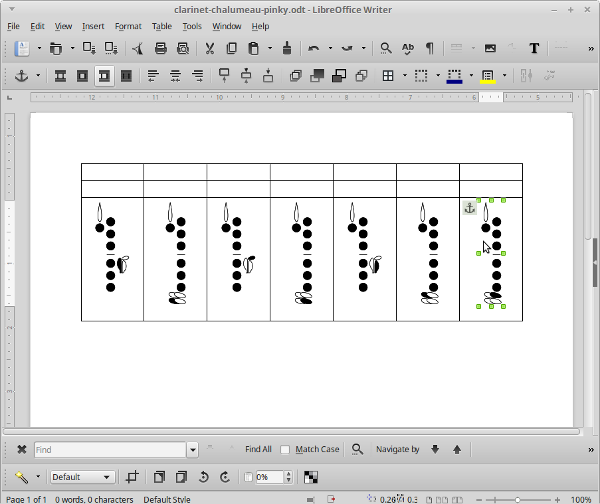
    First I opened a new document and inserted a table. My table has three rows and seven columns.
    writer-table

    Then I dragged the downloaded diagrams from my file manager into the bottom row of the table.

    writer-diagrams

    I merged some cells together, dragged in some images of notes on staves, and added some text.

    writer-complete

    A few more little tweaks and here is the finished chart:

    clarinet-fingering-chart-sample

    Creating an HTML fingering chart in text editing software

    This code be used in any text editor or HTML source editor, and of course similar results could be accomplished with a visual/WYSIWYG editor. I’m not showing complete code here, just the most relevant parts.

    I started with a framework for a table that I could use to show a note with two alternate fingerings. (This is a flute fingering chart with horizontally-oriented diagrams. For an instrument with vertically-oriented diagrams, you may want to rearrange things a bit.)

    <table>
      <tr>
        <th rowspan=2><!— note image here —></th>
        <td><!— first fingering image here —></td>
        <td><!— first fingering text here —></td>
      </tr>
      <tr>
        <td><!— second fingering image here —></td>
        <td><!— second fingering text here —></td>
      </tr>
    </table>
    

    Then I plugged in <img> tags and text:

    <table>
      <tr>
        <th rowspan=2><img src="images/f-sharp-note.png" /></th>
        <td><img src="images/f-sharp-standard.png"</td>
        <td>Standard</td>
      </tr>
      <tr>
        <td><img src="images/f-sharp-trill.png"</td>
        <td>Trill from E</td>
      </tr>
    </table>

    I duplicated that code for additional notes. Since this is a sample alternate/trill fingering chart, each note has at least two fingerings. For notes with more fingerings, I added <tr>s and changed the rowspan values accordingly.

    I also added a little CSS to spruce things up:

    <style>
      table {
        display: inline-block; /* make tables wrap gracefully depending on screen width */
        margin: 1em; /* put some space between tables for legibility/clarity */
      }
      th img {
        max-width: 8em; /* manage size of note images */
      }
    </style>

    Here is the result:

    flute-fingering-chart-sample

    I hope that sparks a few ideas for you if you are considering putting together a fingering chart. If you have other methods or tips, please share in the comments section!

Leave a Reply

Your email address will not be published. Required fields are marked *

Comments that take a negative or confrontational tone are subject to email and name verification before being approved. In other words: no anonymous trolls allowed—take responsibility for your words.

This site uses Akismet to reduce spam. Learn how your comment data is processed.